
Resins: The Medicine We Forgot
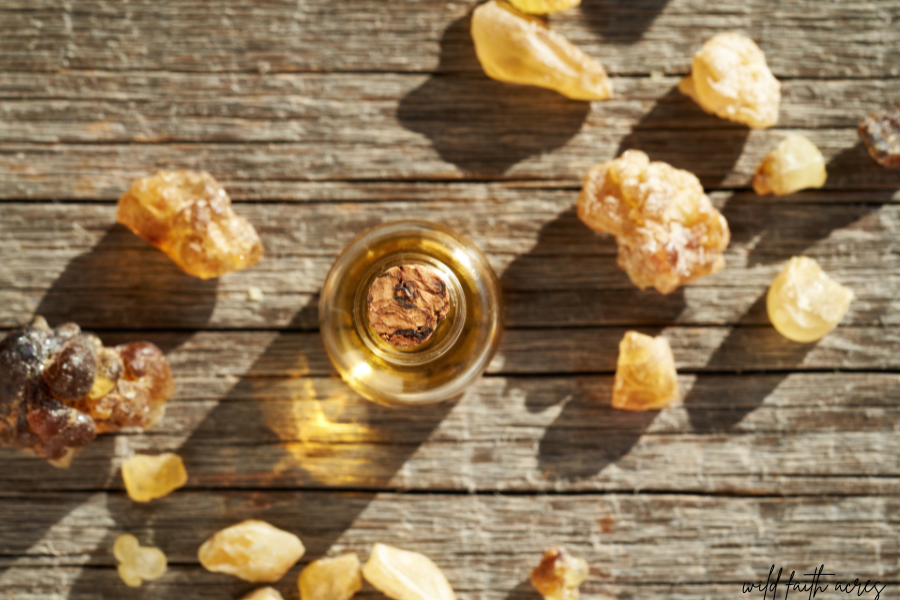
frankincense tear on wood table with bottle of oil in the sunlight
Why frankincense, myrrh, and sacred resins belong in modern skincare
Long before essential oils were bottled, branded, and marketed, the ancient world relied on something far older and far more enduring: resins.
Resins were not fleeting or volatile. They were slow, grounding, and protective. They came from wounds in trees — places where the plant sealed itself, defended itself, and preserved its own integrity. That alone tells us something important. Resins are not created for fragrance or attraction; they are created for protection, repair, and survival.
It is precisely this quality that made resins so valuable to the human body, particularly the skin.
In many ways, resins are the functional opposite of essential oils. Where essential oils stimulate, resins stabilize. Where essential oils act quickly, resins work slowly and deeply. Where essential oils evaporate, resins remain.
Modern skincare largely forgot them — not because they stopped working, but because they require patience, skill, and respect. They are not convenient. They are not trendy. But they are profound.
⸻
What resins actually are
Plant resins are complex mixtures of protective compounds exuded by trees and shrubs when bark or tissue is damaged. Unlike sap, which transports nutrients throughout the plant, resin is a defensive response — a biological sealant designed to protect and preserve.
In the plant, resin functions to guard against bacteria and fungi, prevent moisture loss, repair tissue damage, and maintain structural integrity. That function translates remarkably well to human skin.
Chemically, resins are dense and complex. They contain resin acids, diterpenes and sesquiterpenes, aromatic compounds bound to heavier non-volatile structures, and, in the case of frankincense, boswellic acids that have been extensively studied for their anti-inflammatory properties.
This chemistry matters because it explains why resins behave so differently from essential oils.
Resins are non-volatile or semi-volatile, fat-soluble, stable, and long-acting. They do not rush into the system. They anchor into it.
⸻
Resins in ancient medicine and ritual
Resins appear consistently across ancient civilizations — not as luxury curiosities, but as cornerstones of medicine, preservation, and sacred practice.
In ancient Egypt, frankincense and myrrh were used in embalming, wound care, and skin preservation. Resin-based unguents were valued for their ability to protect tissue and slow decay, and were associated with purification, protection, and longevity.
In Greco-Roman medicine, physicians such as Dioscorides documented myrrh for wounds, inflammation, ulcers, and infections. Resin-based salves were common treatments for burns, lesions, and chronic skin conditions.
In Biblical and Near Eastern contexts, frankincense and myrrh were offered as sacred substances. They were used in anointing, healing rituals, and purification rites, symbolizing incorruptibility, endurance, and holiness.
In Ayurvedic and traditional Chinese medicine, resins were used both internally and externally for chronic inflammation, stagnation, and tissue repair. They were valued not for rapid stimulation, but for their ability to move stagnation while preserving vitality.
Across cultures, resins were not used casually. They were respected. Their slow, grounding nature made them ideal for long-term healing rather than acute intervention.
⸻
Why resins fell out of favor
Resins did not disappear because they stopped working. They fell out of favor because they are inconvenient in a modern, industrialized world.
Steam distillation prioritized volatile aromatics that could be produced quickly and bottled easily. Synthetic fragrance replaced slow botanical processes. Consumers became accustomed to immediate sensory payoff — strong scent, fast sensation, rapid feedback.
Resins, by contrast, require long infusions or specialized extraction. They do not produce sharp or dramatic aromas quickly. They cannot be used casually or cheaply. They demand formulation knowledge and time.
Essential oils were easy to scale. Resins were easy to forget.
⸻
How resins interact with the skin
Resins work with the skin rather than overriding it.
Biologically, resins tend to support barrier repair, reduce chronic inflammation, encourage tissue regeneration, and provide antimicrobial protection without excessive stimulation. Because they are fat-soluble and non-volatile, they remain in the skin longer, do not “flash off,” and are less likely to trigger sensitization when used appropriately.
Rather than provoking a response, resins reinforce structure.
This makes them particularly well-suited for dry or compromised skin, aging skin, eczema-prone or reactive skin, post-inflammatory healing, and formulations designed for long-term barrier repair.
Resins do not wake up the skin. They restore it.
⸻
Frankincense: the resin of regeneration
Frankincense (Boswellia spp.) is one of the most studied resins in both ancient and modern contexts. Traditionally, it was used for wound healing, inflammation, scar support, and spiritual grounding.
Modern research has focused on boswellic acids, which demonstrate anti-inflammatory activity and support for tissue repair and immune modulation.
In skincare, frankincense resin supports skin tone and elasticity, reduces redness, strengthens barrier resilience, and contributes to long-term skin vitality. Unlike frankincense essential oil — which is lighter, more aromatic, and more stimulating — the resin works quietly and deeply.
⸻
Myrrh: the resin of protection and repair
Myrrh (Commiphora spp.) has historically been used where tissue integrity was compromised. Ancient uses included wound cleansing, oral health support, skin infections, and preservation of tissue.
Myrrh resin is known for its strong antimicrobial properties, astringent yet soothing action, and ability to support damaged or weeping skin. In skincare formulations, myrrh strengthens compromised tissue, supports healing without over-drying, and offers protection without irritation.
It is particularly valuable in products designed for sensitive, mature, or inflamed skin.
⸻
Benzoin: the resin of comfort and preservation
Benzoin resin (Styrax spp.) is often misunderstood as merely a vanilla-like fragrance. Historically, it was valued for skin protection, respiratory support, and emotional grounding.
Functionally, benzoin acts as a natural preservative, supports the skin barrier, offers gentle antimicrobial action, and brings warmth and cohesion to formulations. When paired with fats and waxes, it contributes both function and comfort.
⸻
Why resins pair so well with tallow and fats
Resins and animal fats were historically used together for a reason.
Tallow closely mimics human sebum, delivers fat-soluble nutrients, and supports barrier integrity. Resins anchor into fats, extend their function, add medicinal depth, and improve longevity and stability.
Together, they create skin-identical nourishment, long-lasting protection, deep tissue support, and formulations that feel whole rather than fragmented.
This is not cosmetic chemistry. It is physiological alignment.
⸻
CO₂ extracts: a modern bridge to ancient medicine
CO₂ extraction allows access to resin chemistry without the volatility or harshness of steam distillation. This method preserves heavier resin compounds, offers greater stability, reduces irritation potential, and yields more complete chemical profiles.
CO₂ resin extracts provide a bridge between ancient wisdom and modern precision — making resins more accessible without compromising their integrity.
⸻
Choosing resins over essential oils — and when to use both
Resins are ideal when long-term skin health is the goal, when skin is compromised or reactive, when daily leave-on products are involved, and when barrier repair is needed.
Essential oils may still be appropriate when short-term stimulation is beneficial, aromatic impact is intentional, or acute situations require targeted support.
This is not an either-or decision. It is discernment.
Mature formulation is not about using everything. It is about choosing the right tool for the right purpose.
⸻
A return to slower skincare
Resins invite us to slow down. They do not offer instant results or dramatic sensations. They work quietly, cumulatively, and faithfully — much like the healing process itself. In a world that prizes immediacy, resins remind us that some forms of medicine are meant to take time. And perhaps that is why they are being remembered now.
Continue the series
This article is part of a four-part series exploring essential oils, resins, and thoughtful skincare formulation:
• Part One: Essential Oils: History, Truth, and Proper Use
• Part Two: Resins: The Medicine We Forgot
• Part Three: Essential Oils, Resins, and Whole-Plant Preparations (coming soon)
• Part Four: How to Choose Skincare That Works With Your Skin, Not Against It (coming soon)