
Tallow, Truth, and Letting Myself Be Wrong: A Humble Exploration of an Ancient Ingredient
(And Why I’m Finally Adding It to My Skincare Line)
If you had told me a few years ago that I’d be rendering beef suet in my kitchen, triple-filtering it, and preparing to incorporate it into a skincare product… I probably would have smiled politely and thought, “Absolutely not.”
I was deeply, sincerely, firmly anti-tallow.
Not because I didn’t understand its history, but because every piece of information I had absorbed over the years made it sound like something I wanted nowhere near my face — or my brand. I had built my world around plants: plant remedies, plant oils, plant butters, plant medicine, plant infusions. Tallow felt like a different philosophy entirely, and not one I felt called toward.
But here’s the truth we don’t always like to admit out loud…
Sometimes the things we resist the most are the things we understand the least. And sometimes humility looks like letting new information reshape old opinions — especially when those old opinions were built on half-truths, outdated data, or hype-fueled misconceptions.
This is my honest, humble confession:
I was wrong about tallow.
And this is the story of how I learned that — slowly, reluctantly, but openly.
How I First Learned About Tallow (and Why It Immediately Became a “Nope”)
My introduction to tallow skincare years ago was… not great.
The first tallow balm I ever encountered smelled unmistakably like beef. And if there’s one thing I do not want to smell when moisturizing my face, it’s a cheeseburger.
From there, the negatives stacked up quickly:
“It’s comedogenic.”
“It’s too heavy for the face.”
“It can cause breakouts.”
“It’s greasy.”
“It’s a fad.”
And to be fair? Some of those things were true — at least partially — especially in the way tallow was being handled by beginners: using random beef fat trimmings, rendering too hot, failing to filter, mixing with heavy oils, or creating waxy, greasy textures that never fully absorbed.
On top of all that, I watched the tallow trend explode online, and as someone who is not drawn to hype or quick trends, I quietly stepped back. My heart has always been to create products rooted in truth, experience, herbal wisdom, and integrity, not virality.
So for years, tallow stayed firmly in my “not for me, not for my brand” category.
And honestly? At the time, I think I made the right call.
What Changed: My Reluctant Curiosity Meets My Commitment to Learning
Fast forward to the beginning of 2025. I had a really cool idea for a skincare product that uses only Michigan-sourced ingredients, and in my research I realized that I would really need to reconsider tallow or bounce on this idea… it simply couldn’t work without it. I started to see that tallow was very much a necessary ingredient to ancient skincare, and that really challenged me.
I knew my parents were purchasing a cow from a local farm several months later, so I asked if I could have the suet from around the kidneys — what traditional herbalists and formulators call the “leaf fat,” or the cleanest, purest, least aromatic fat on the animal. Out of curiosity more than anything, and a desire to not miss out on getting some quality suet in my hands, I took on a project that truly challenged me to rethink what I thought I knew.
But I still wasn’t convinced… yet.
Meanwhile, my mom was quietly struggling with stubborn dry patches on her face — dry spots that even my herbal-infused oils and my deeply hydrating salves could improve but not completely resolve. And somewhere in that space — where curiosity meets compassion — I found myself wondering whether there might be something I had overlooked.
So I joined a tallow formulation group quietly and observantly. I started reading. Listening. Observing. And this time, something felt different. I wasn’t listening to hype. I wasn’t listening to trends. I was listening to formulators with decades of experience, users with skin stories that sounded like my mom’s, herbalists using tallow in a way that honored both tradition and modern science, people rendering suet with great care and producing crystalline white, neutral-smelling tallow — alongside discussions about skin barrier function, updated comedogenicity research, and the biochemical structure of human sebum versus plant oils versus animal fats.
And slowly, cautiously… something in me softened.
The Science I Ignored the First Time
If we’re being honest, most of us don’t become anti-tallow because of science. We become anti-tallow because of bad past experiences, misinformation, strong personal preference, “ick factor,” marketing-driven fear, or cultural disconnect from traditional food and skincare practices. But when you strip all that away and look at what tallow actually is… you find something surprisingly beautiful.
Here’s what finally caught my attention:
Tallow’s fatty acid profile is remarkably similar to our own skin.
Human sebum and properly rendered beef tallow both contain:
Stearic acid → supports a strong, elastic skin barrier
Palmitic acid → deeply moisturizing and protective
Oleic acid → enhances absorption (especially good for mature or dry skin)
Linoleic acid → essential for barrier repair and soothing inflammation
This means the skin doesn’t just tolerate tallow — it actually recognizes its structure and uses it readily.
Plant oils are wonderful, but none of them match our own lipid profile the way tallow does. I didn’t know that. Or maybe I knew it once, but I hadn’t yet taken the time to study it deeply and to really let it shape my perspective.
The comedogenic charts were outdated and misleading.
A lot of the anti-tallow information floating around comes from old comedogenicity scales that used beef fat trimmings — not kidney suet, not purified tallow and not modern skincare formulations.
They weren’t comparing apples to apples.
In practice? Properly rendered kidney suet tallow is far less comedogenic than coconut oil, cocoa butter, or even some nut oils. Does that mean it’s perfect for acne-prone skin? No — and I won’t pretend it is. But for dry skin, mature skin, barrier-damaged skin, winter-stressed skin, sensitive or reactive skin, tallow often performs better than plant oils alone.
The “beef smell” is not inherent — it’s a rendering problem.
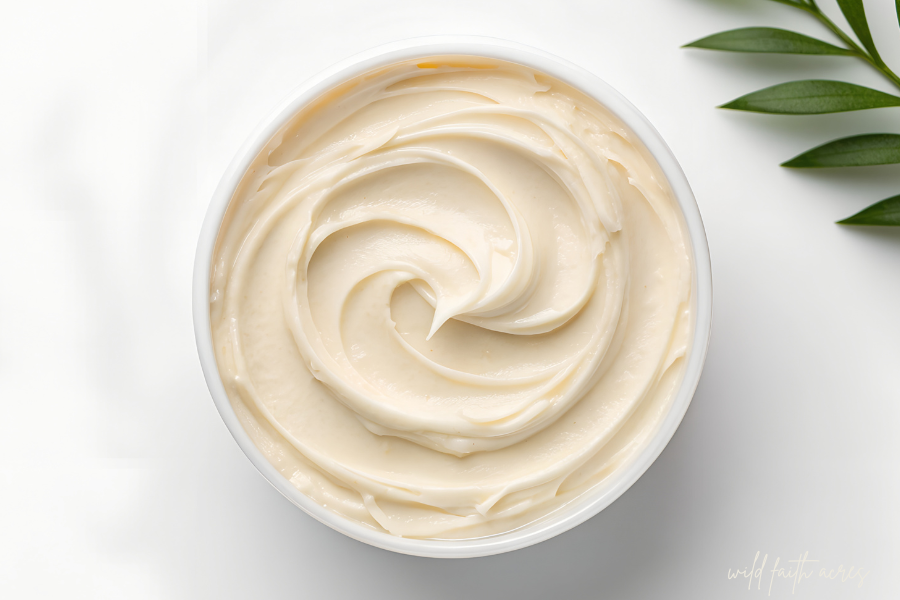
When tallow is dry-rendered low and slow, purified, strained, filtered through cotton or coffee filters, and sourced from clean suet around the kidneys, it becomes snow-white, clean, neutral, and odorless.
Not a hint of beef.
This was the moment my guard lowered because the smell was honestly my biggest aversion.
Where Tradition and Modern Herbalism Meet
As I studied more, I realized something else: tallow has been used for thousands of years in skincare and medicine.
It’s part of Biblical-era ointments, traditional European herbal salves, Indigenous healing balms, and Early American homestead apothecaries. And somewhere along our modern journey, we became disconnected from that part of our heritage. I wrote more about this history in my article on Ancient Skincare: Oils, Butters, and the Wisdom of Tradition.
But herbalism has always been about using the ingredients God gave us — plants, yes, but also the resources provided by the animals we steward and consume.
There’s something deeply holistic, deeply rooted, deeply ancestral about returning to these old ways with respect and understanding. I wasn’t embracing a trend, I was remembering a tradition.
Why I Decided to Add Tallow to My Brand (Carefully, Intentionally, and with Integrity)
After weeks of reading, researching, and reflecting, this became clear: I don’t want to add anything to my line because it’s trending. I don’t want to add anything because it’s aesthetically pleasing. Or because it sells well. Or because it’s popular online.
I only want to add ingredients that work, heal, nourish, support whole families, and actually make a difference. And as much as I resisted this truth…
Tallow does exactly that.
And it does it better than many plant-based options for certain skin types and concerns. It won’t replace plant oils. It won’t take over my brand. It’s not becoming the new main character. But it deserves a seat at the table.
Especially for dry, winter skin, mature skin, eczema-prone skin, barrier repair, persistent dry patches (like the ones my mom has struggled with for years), cold weather protection, and nourishing, wholesome, deeply reparative balms and butters.
So I rendered my first batch of suet — carefully, prayerfully, hoping I wouldn’t regret it.
It came out white. Clean. Beautiful.
And when I blended it into a test formula with my herbal oils, something clicked. This could truly help people, not because it’s trendy, not because it’s hyped, but because it works.
What I Want You to Know (My Honest Message to You)
I’m very excited to widen my toolkit — just like herbalists have done for thousands of years. I’m not vegan and I never have been, so it seems natural to lean into this ancient ingredient to offer a better, more complete array of products that will help people. Wild Faith Acres exists to help people, to support health and skin, and to teach people the ancient ways.
I want to use the most effective, gentle, nourishing ingredients for each person and each season, and for some skin types, tallow might be that missing piece.
I resisted it because I didn’t understand it. I misunderstood it because I hadn’t taken the time to learn, and what I did learn was about trimmings and not suet — and that truly does make a difference. And I hadn’t taken the time to dive deeper because I didn’t think I needed to, I thought I understood enough.
That slow process — rendering, purifying, and blending tallow with herbal oils — eventually became the foundation for a winter body butter I’ll be releasing soon.
I’m grateful I allowed myself to be wrong. Because it means I can serve better now — with deeper understanding, greater care, and ingredients chosen not by trend, but by truth.
If you’d like to explore the history behind this journey, you can read Ancient Skincare: Oils, Butters, and the Wisdom of Tradition here.